
Cherokee County Court Records After Arrest
The path from a Cherokee County jail arrest to court records is not the same as a jail roster search. The jail booking charge is the law-enforcement intake allegation. After that, the prosecutor reviews the facts, decides what to file, and the court record opens through the proper clerk. The filed charge may match the booking language, but it may also be amended, reduced, enhanced, rejected, or replaced by a different charge.
For felonies and district-level criminal filings, the Cherokee County District Clerk is the main records route. The District Clerk page lists Alison Dotson, 135 South Main, 2nd Floor, Rusk, TX 75785, phone 903-683-6908, office hours 8 a.m. to noon and 1 p.m. to 4 p.m. Monday through Friday excluding holidays, and email dcoffice@cocherokee.org. The page also says civil, criminal, and family filings must be e-filed with the District Clerk Office as of November 1, 2018.
For custody or booking facts before a case exists, use the Cherokee County jail inmate records path. For booking photos, use the Cherokee County jail mugshots route and sheriff records request process.
Find Cherokee County Court Records
No free county-hosted public criminal case-search portal was located on the inspected Cherokee County pages. That means a court records after jail arrest search often starts with a clerk request by name, date of birth if known, arrest date, charge, case number if known, and the court or offense level. Very recent arrests may not have a filed court case yet, even when the person has already been booked into jail.
Timing matters. A person may be booked before a complaint, information, indictment, or court setting is visible through a clerk. If the arrest is recent, first confirm custody or release with the jail, then check back with the clerk once the prosecutor has had time to file or decline charges. The clerk is the better source for court records after filing, while the sheriff is the better source for the booking event.
| Search route | Type | Required detail | Notes |
|---|---|---|---|
| County public case portal | Not located | n/a | No county-hosted criminal case search was found in inspected pages. |
| District Clerk request | Phone, email, or in person | Defendant name, DOB if known, case number if known | Use for felony and district criminal records. |
| County-level routing | Clerk or county court route | Name, arrest date, charge, court if known | Useful for misdemeanor and county-court matters. |
| E-filing | External filing system | For filings, not public search | District Clerk states criminal filings must be e-filed. |
The official District Clerk source page shows the local records office details used for felony and district-court routing.
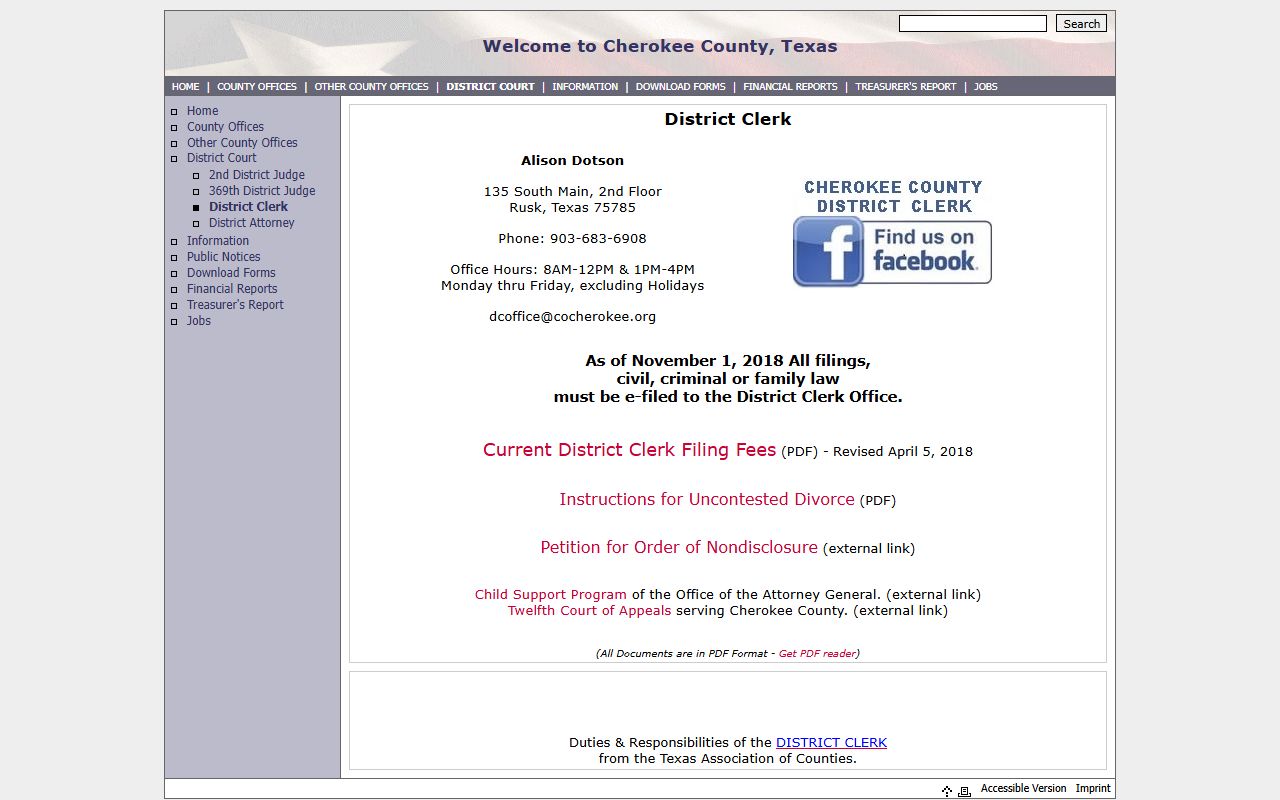
That source supports clerk-based searching instead of a fictional public case-search form.
Cherokee County Arrest Charge vs Court Charge
After a Cherokee County jail arrest, a booking charge and a court charge answer different questions. A booking charge shows why the person entered jail. A filed court charge shows what the prosecutor and court are actually moving forward. Bond paperwork, warrants, complaint language, and indictment status can all affect what appears later in court records.
| Record type | What it shows | Where to check |
|---|---|---|
| Booking charge | Arrest or intake allegation at the jail | VINELink, jail phone, sheriff records request |
| Filed charge | Charge accepted or changed for prosecution | District Clerk, County Clerk/court route, prosecutor |
| Conviction | Final adjudicated outcome, plea, or judgment | Court record and official criminal-history channels |
Important: An arrest is not a conviction, and a jail booking record is not the final court record.
Cherokee County Charging Documents
Charging documents explain how the court case is opened or advanced. The names can overlap in casual speech, so it helps to match the document to the stage of the case. Felonies often move through prosecutor review and grand-jury indictment. Some cases use complaint or information language depending on offense level and procedure.
| Document | Meaning after a jail arrest | Record route |
|---|---|---|
| Complaint | A sworn allegation or charging paper depending on case stage. | Clerk, court, or prosecutor route. |
| Information | A prosecutor-filed charging instrument often used in non-indicted cases. | County or district court route, depending on offense. |
| Indictment | A grand-jury charging instrument for felony prosecution. | District Clerk and district court record. |
The District Attorney's Office prosecutes felony and district-level criminal charges. A 2026 Governor appointment notice named David Broom as District Attorney of the 2nd Judicial District in Cherokee County for a term expiring December 31, 2026, or until a successor is elected and qualified. The county DA page supplies office phone, fax, hours, and victim coordinator details.
Cherokee County Prosecutor Records
The District Attorney page lists phone 903-683-2573, fax 903-683-2309, office hours Monday through Friday, 8 a.m. to noon and 1 p.m. to 5 p.m., and victim coordinator Regina Brooks at 903-683-2718. The County Attorney page lists Dana Young at 135 S. Main, 1st Floor, Rusk, TX 75785, phone 903-683-2423, fax 903-683-5931, and email coattorney@cocherokee.org. The prosecutor's office does not replace the clerk for court records, but it can explain prosecution roles, victim services, and filed-charge context.
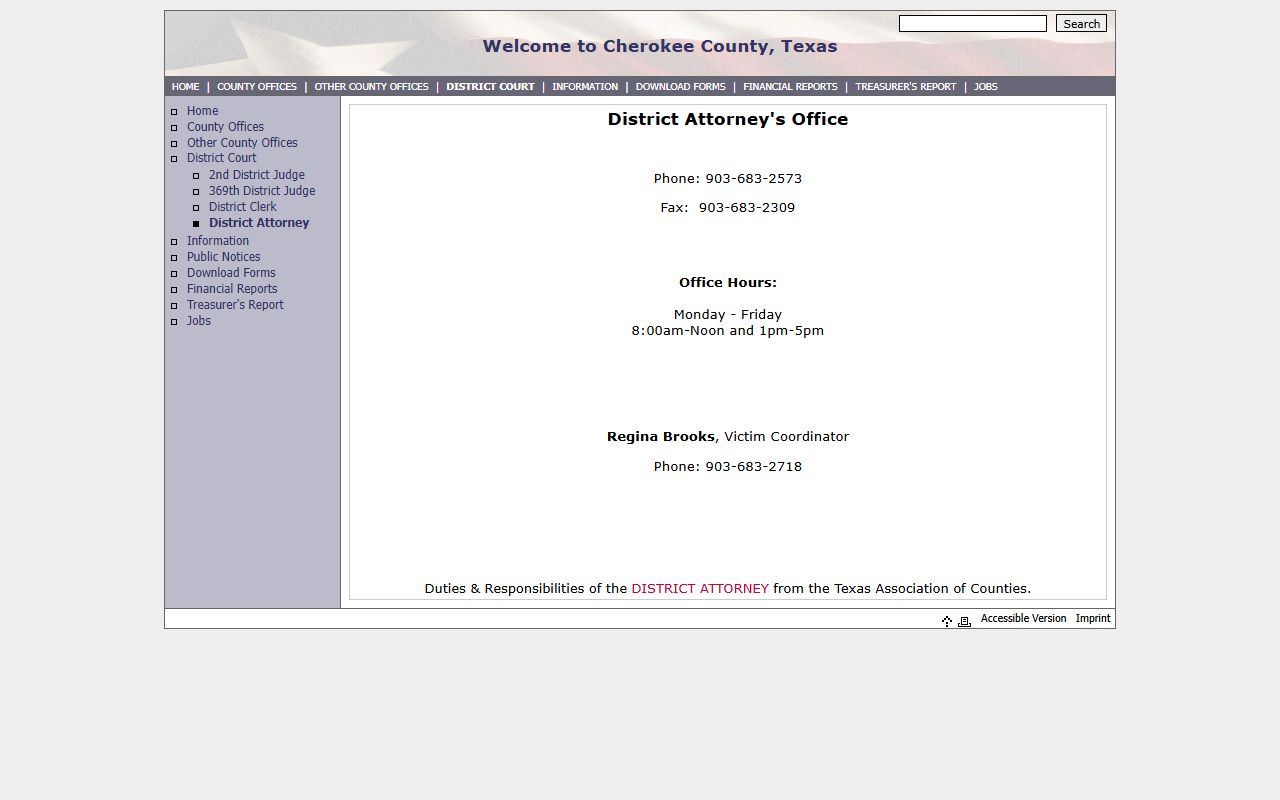
The District Attorney page is useful for prosecution context after arrest, while the clerk remains the records custodian for filed district cases.
| Office | Role after arrest | Contact found |
|---|---|---|
| District Attorney | Felony and district-level prosecution | 903-683-2573 |
| District Clerk | District criminal filings and records | 903-683-6908, dcoffice@cocherokee.org |
| County Attorney | County-level prosecution context | 903-683-2423, coattorney@cocherokee.org |
Cherokee County Bond and Warrants
Bond is tied to the court and magistrate process, even when the jail can confirm whether a person is releasable. Texas Code of Criminal Procedure Chapter 17 governs bail. A person may have a cash bond, surety bond, personal bond, property-secured bond where accepted, or no-bond/hold status. A parole hold, out-of-county warrant, federal hold, or ICE detainer can block release even when one charge has a dollar bond.
| Status | Meaning | Search note |
|---|---|---|
| Pending | Filed case not resolved | Check clerk record for settings and filings. |
| Amended | Charge or document changed | Compare booking language to filed court language. |
| Dismissed | Charge ended without conviction | Dismissal does not automatically erase all public records. |
| Warrant or capias | Court-issued arrest authority | Contact the issuing court or clerk. |
| Disposed | Final outcome entered | Confirm with court records, not jail status alone. |
No official Cherokee County Sheriff's Office active-warrant search page was located. For warrant-related court records after an arrest, contact the issuing court, District Clerk, or appropriate municipal court. Do not rely on commercial databases or rumors when an active warrant can lead to immediate arrest.
Cherokee County Court Records Limits
Official criminal history is not the same as a jail roster or a local clerk file. Texas Government Code Chapter 411 governs criminal-history-record information and dissemination. DPS or state-authorized criminal-history channels may have fees or identity restrictions. A local jail record can show booking facts, while a court record can show filed charges and outcomes. Neither should be treated as an FCRA background report.
Expunction and nondisclosure issues also affect public access. Texas Code of Criminal Procedure Chapter 55 governs expunction for eligible records. Juvenile records, sealed records, expunged records, protected victim details, active investigations, and confidential information may be withheld or redacted. When a case has been dismissed, ask the clerk or an attorney about record status rather than assuming every public record disappears.
Older files may require a more specific request. Provide the defendant's full name, date of birth if known, approximate arrest date, charge, court, and case number if available. If the case moved from jail booking to indictment or disposition, ask for the court file rather than the jail record.
- Expunction
- Legal removal or destruction of eligible records under Texas law.
- Nondisclosure
- A sealing-like order that limits public access to certain records.
- Disposition
- The final court outcome, such as dismissal, plea, judgment, or other resolution.